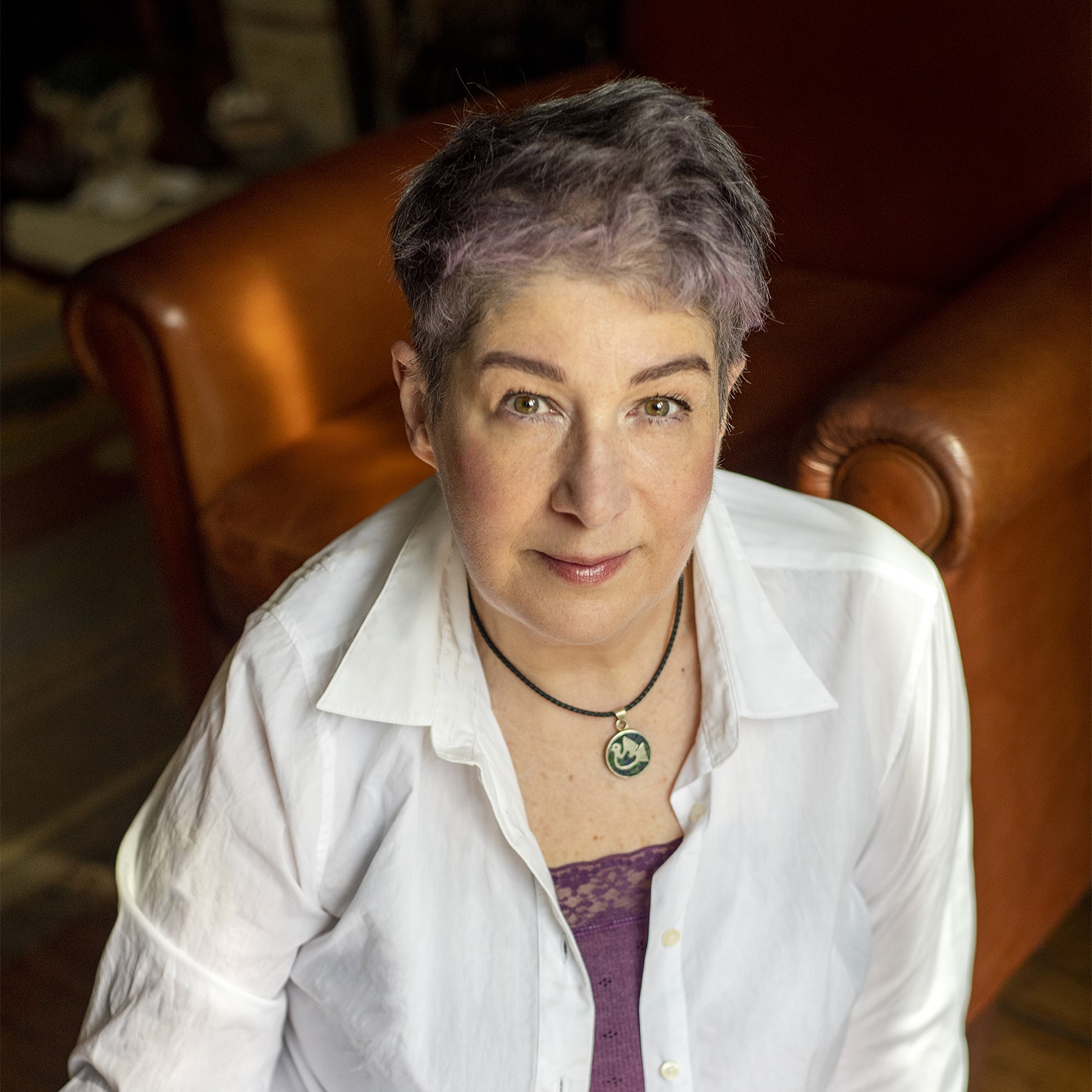

This article first appeared in the November/December 2025 edition of Style of Wight magazine. Words by Rebecca Lawson. Photography by Kyte Photography.
From Chocolat to Viande, Joanne Harris has spent a lifetime exploring the hidden corners of human desire, myth, and memory. At this year’s Isle of Wight Literary Festival, the acclaimed author spoke with quiet power about creativity, ageing, and the magic found in the everyday.
The afternoon is cool and bright in Cowes, the sea visible in soft glimpses between Georgian rooftops. Inside Northwood House, where the Literary Festival hums into life, a sinuous line of book-lovers queue for a seat. The scent of coffee and salt air mingles with the faint rustle of pages and the murmur of conversation. Almost everyone is clutching a hard-cover copy of the recently released novel Viande, prequel to the cult classic Chocolat.
The audience is seated in the large reception rooms, where sunlight slants across rows of chairs and catches the edge of a stage and sofa. Joanne Harris enters without fuss and takes her seat. She is small in stature, dark curls framing her face, a presence that makes you want to stop and listen, to crane your ears for every word. She has the kind of poise that doesn’t need any fanfare; she is articulate and her words are infused with the same spark of curiosity that animates everything she writes.
She speaks of Viande, the lead character from her Chocolat series, in measured tones, musical and layered with warmth. It is clear she knows her well; “Viande and I have aged together,” she says, “and are now more or less at the same stage of two very different lives.”
Harris’s conversation, much like her novels and Viande herself, slips easily between the ordinary and the mythic. She sews magic into everyday life, so you accept it as fact. “I think people respond to the emotional truth of things, not necessarily what’s literally true,” she explains, her tone reflective. “It’s more about what feels real than what actually is.”
It’s that emotional truth that has made Harris one of Britain’s most distinctive literary voices. Her 1999 novel Chocolat – a tale of faith, temptation, and the magic of chocolate – became a modern classic, adapted into an Oscar-nominated film starring Juliette Binoche and Johnny Depp. This may have been a defining moment in her career, but Harris herself never stood still. Her work since has ranged from psychological thrillers to Norse retellings and ghost stories, each one stitched with her signature blend of folklore, sensual detail, and quiet rebellion.
After her talk has wound to a close, Harris and I chat further. When she talks about her childhood, it’s easy to see that her love of myth and memory took root long before Chocolat made her a household name. With a French mother and an English father, she grew up straddling two languages and two cultures – belonging to both yet somehow caught between them. “One of the unique things about being from two cultures,” she says, “is that wherever you go, you are always going to be at least half foreign. This makes for an interesting perspective for a writer. It means that you interact with people slightly differently and have a different sense of what belonging means.” It is from this liminal space that Harris has been able to create such multi-dimensional characters as Viande, and this is vital to the longevity of her stories. She explains, “It’s the tension between two realities that gives a story breath.”
It’s hard not to notice how seamlessly transitional spaces seep into other themes in her work as well, such as the boundaries between myth and reality. Her readers, too, seem to inhabit that in-between state — half believing in the magic, half aware that it’s a mirror for something closer to home. It’s what makes Harris’s stories endure: the uncanny sense that what she’s describing could, in the right light, be real.
Magic, it turns out, is a practical craft in Harris’s world. She approaches writing like a musician — unsurprising for someone who plays flute and bass guitar — composing her novels in rhythm and tone as much as plot.
“Language has cadence,” she says. “A sentence can rise, fall, or hold its breath. I want the reader to feel that.” But there’s something deeply grounded about her, too — a Yorkshire earthiness beneath the lyricism. She’s warm, quick-witted, occasionally wry, and entirely unpretentious.
She laughs when asked if she’s ever tempted to step away from the supernatural altogether. “I don’t think I could,” she admits. “The definition of between religion and myth, or folklore and superstition are culturally dependent – all of those things exist on a sliding scale. One person’s myth is another person’s religion. So you see, I’m not really writing about magic — I’m writing about emotion, perspective and what we can’t explain.”
Emotion and human nature both seem to be something Harris instinctively understands, but it is hard-won knowledge. “I wouldn’t have been capable of writing about things too far outside my own experience,” she explains. “If you’re going to write grief, you have to have known grief. If you’re going to write about feeling like an outsider, then it helps to have felt like that. Emotional realism rather than literal realism is what I’m talking about here. Emotional realism is what links us and those are generally universal experiences to some degree.”
While discussing lived experience, our conversation shifts to the changes in the publishing industry between when she started writing and now — from the rise of social media to the quiet encroachment of AI in creative fields. Her response is measured but firm and candid: “Technology can reproduce style, but it can’t reproduce empathy — and that’s the heartbeat of writing. The job of a writer isn’t to produce words — it’s to create connection.”
That word — connection — threads through everything Harris says. Connection between writer and reader, past and present, myth and truth. Even the way she talks about her characters feels like she is describing old friends, especially Viande. “We’ve travelled alongside each other,” she admits. “When I wrote Chocolat, I was a young mother, full of questions about identity and belonging. Now I’m in a different phase of life, so my stories reflect that. I think when you reach a certain age, memory becomes important, and you start looking back, which is how I have been able to travel back in time and write about Viande’s early life after already creating her later life.”
Harris is unafraid to talk about ageing — in her work, her body, her career. “I think as you get older your writing inevitably changes. The way you see the world shifts, how you experience colours, everything. You start to care less about how people will perceive your work and more about what you actually want to say.”
That shift, she adds, is part of why she continues to write — to map those changes, to make sense of the evolving landscape of being human. “Stories are how we make sense of being human. They help us look at ourselves — sometimes not too kindly — but with a kind of compassion that allows us to keep going.”
As our conversation draws to a close, the October light is beginning to lengthen the shadows on the lawns of Northwood House stretching out towards the Solent. Harris asks for directions to her next engagement. I point the way down to town and for a moment she stands looking out over the lawns, half in reflection. There’s something fitting about her presence here, on an island surrounded by thresholds – land meeting sea, history brushing against the present. Like her stories, the Isle of Wight exists in the in-between, a place where the edges blur and imagination has room to breathe. Perhaps this is why our little Island has always had such a strong link to literature and creativity.
Then Joanne turns and, smiling, disappears into the soft Island air, leaving behind a trace of wonder that doesn’t fade.